
For many years now, farmers have been told they need to breed and farm low methane emitting animals, or they run the risk of facing being taxed on their animals’ methane emissions.
Research has shown that there is a large range within breeds, within sire lines and within management groups of how much methane beef animals emit. All good – surely if we know the high emitters and the low emitters, we can breed from the ones we want to see more of in our herd – those whose emissions are lower.
But have we unlocked why some animals are higher emitters than others?
Methane emissions in cattle are primarily influenced by the amount and type of feed they eat, their individual body size and productivity, and the microbial makeup of their digestive system. Larger animals tend to eat more, and emit more, but if they produce more, then the emissions intensity is lower as it is spread over greater productivity.
Methane traits in cattle have been found to be moderately heritable, meaning some individual animals naturally produce less methane than others due to differences in their digestive efficiency and internal microbial populations.
But if breeding lower emitting animals is tied to breeding less efficient and less productive animals, beef producers would be shooting themselves in the foot and going backwards. Breeding less efficient and less productive animals to save methane emissions would be counter productive for the industry.
Millions of dollars have been invested in the whole methane research area over the past 20 years and now research work into methane efficiency is going on all around the world.
Beef organisations and research partners are investing significantly in determining whether methane efficiency is sufficiently heritable to incorporate into routine genetic selection.
The American Angus Association has been running active methane-efficiency research examining the genetic influence on methane and its relationship with other economically important traits.
According to the American Angus Association website the study will evaluate the effective capture of methane emission records, the genetic drivers of methane emissions, and the potential to select for these traits. The resulting records will enable examination of genetic drivers of metabolic heat production and allow for investigation into genetic correlations with other economically relevant traits. Understanding, these differences may provide valuable insights into cow intake, efficiency, and energy loss under grazing conditions. The findings could contribute to the development or refinement of selection tools that potentially enable producers to identify and select cattle who emit less methane and are more efficient.
The project focuses heavily on grass-grazing cows rather than feedlot cattle to better understand natural energy use and researchers are evaluating heritability to see if lower methane traits are heritable so breeders can make permanent, multi-generational progress. The work ensures that selecting for reduced emissions does not unintentionally harm growth rates, fertility, or carcase quality.
In Australia, the Meat & Livestock Australia’s (MLA) Low Methane Beef project is a collaborative research initiative designed to breed cattle that produce lower methane emissions while maintaining or improving farm productivity. The project goals include reducing emissions permanently, through cutting cattle methane production by about 1% each year through genetic selection, but ensuring that breeding for lower gas output does not harm growth rates, fertility, or meat quality and to develop genomic Research Breeding Values (RBVs) to help farmers choose low-emitting breeding stock.
The project has delivered its first genomic RBVs for methane emissions, giving producers an alpha tool for selection and collaborating breeders and commercial producers are beginning to test and apply the metrics to future herd management.
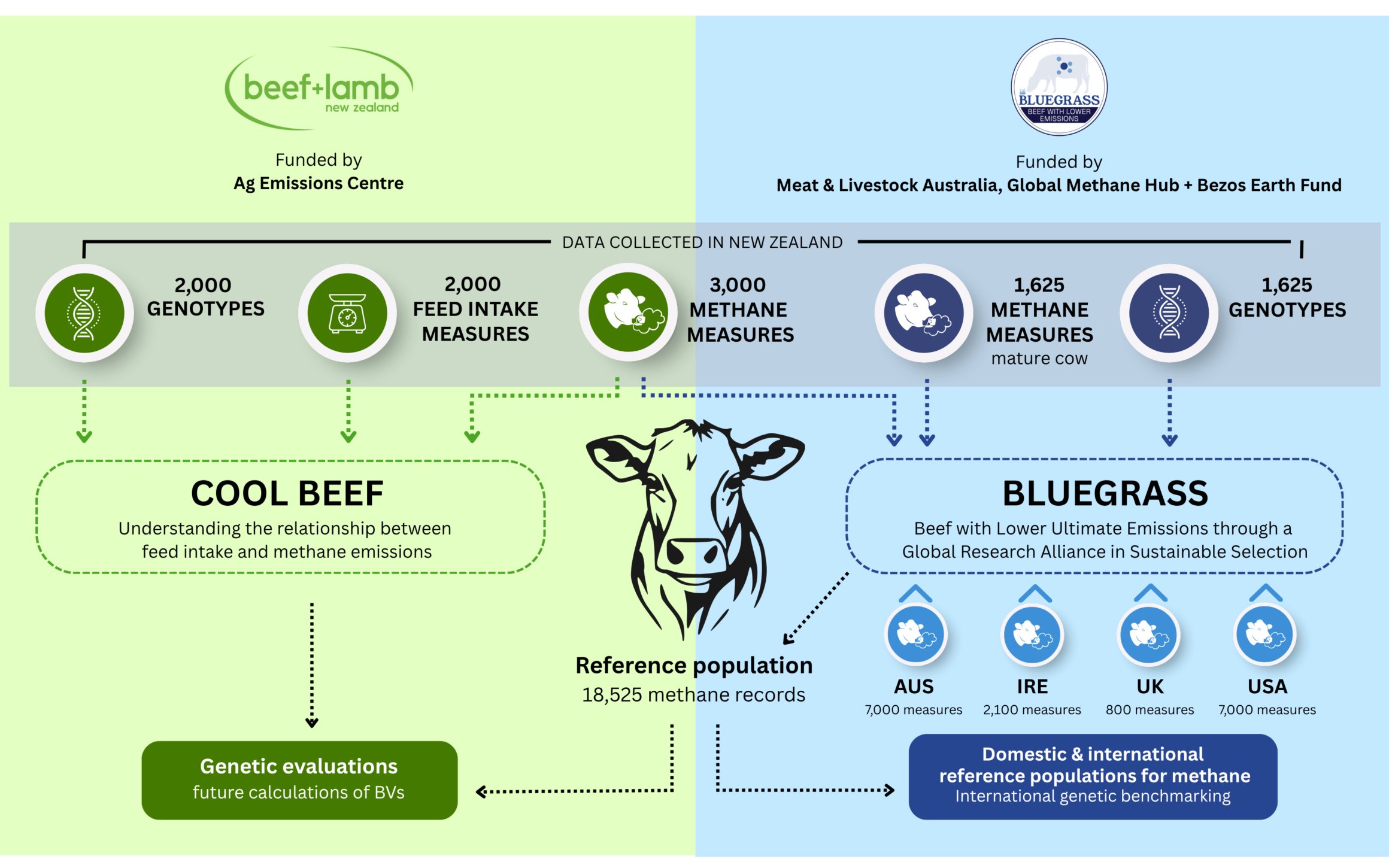
In New Zealand, Beef + Lamb Genetics have recently announced a four year programme funded by the Ag Emissions Centre designed to develop genetic tools for methane emissions and feed efficiency in NZ beef cattle.
The Cool Beef programme follows a similar research in sheep which began in 2019 looking for low emissions sheep and then a dairy programme which kicked off in 2021.
Buy in and use of animals from four Angus breeders and four Hereford breeders has made this a truly collaborative project, said Beef + Lamb Genetics beef project delivery lead Posy Moody.
“It is early days for the Cool Beef project but we have had fantastic collaboration from breeders – we couldn’t do it without their animals to measure . The breeders know this will impact the whole of New Zealand agriculture.”
At least 2,000 cattle will be measured for methane and feed intake, with another 1,000 methane measurements from cattle directly off pasture. Angus, Hereford and crossbred cattle are involved, with the work intended to contribute to future EBVs for methane and feed-efficiency traits.
Methane measurements are currently being collected using Portable Accumulation Chambers (PACs) developed by the Bioeconomy Science Institute (BSI) with the possibility that other methane measuring technologies will be used over the coming years.
The programme will investigate how methane emissions and feed efficiency relate to important production traits, helping determine the potential for these traits to be incorporated into future breeding approaches.
“Everyone wants different things – beef producers and breeders want more efficient and productive animals, food manufacturers and exporters want lower carbon beef and the governments wants lower actual methane emissions.”
“If we can increase feed efficiency and productivity at the same time as decreasing methane, that impacts three different groups positively,” said Posy.
Alongside the Cool Beef project, is the international Bluegrass Project funded by MLA, the Global Methane Hub and the Bezos Earth Fund. Ireland, Australia, New Zealand, UK and USA are all contributing data from methane measured cattle to build a reference population of 18,525 methane records.
“Bluegrass is searching for beef with lower ultimate methane emissions through a Global research Alliance in sustainable selection.” Posy said.
“Without having to actually fund the project, NZ benefits from this collaboration by getting access to a reference population quicker, allowing the faster generation of individual RBVs.”
“The real opportunity is identifying cattle that eat efficiently, grow efficiently, reproduce efficiently and emit less per kilogram of beef produced.” , said Jane Allan, General Manager of Angus NZ.
“This moves the methane conversation away from simply asking farmers to reduce emissions and towards breeding cattle that are simultaneously efficient, productive and lower emitting. That fits extremely well with Better Balanced Beef – the Angus NZ mantra,” said Allen.