

The United States is facing an extraordinary beef supply squeeze – and the consequences are being felt well beyond American ranch country.
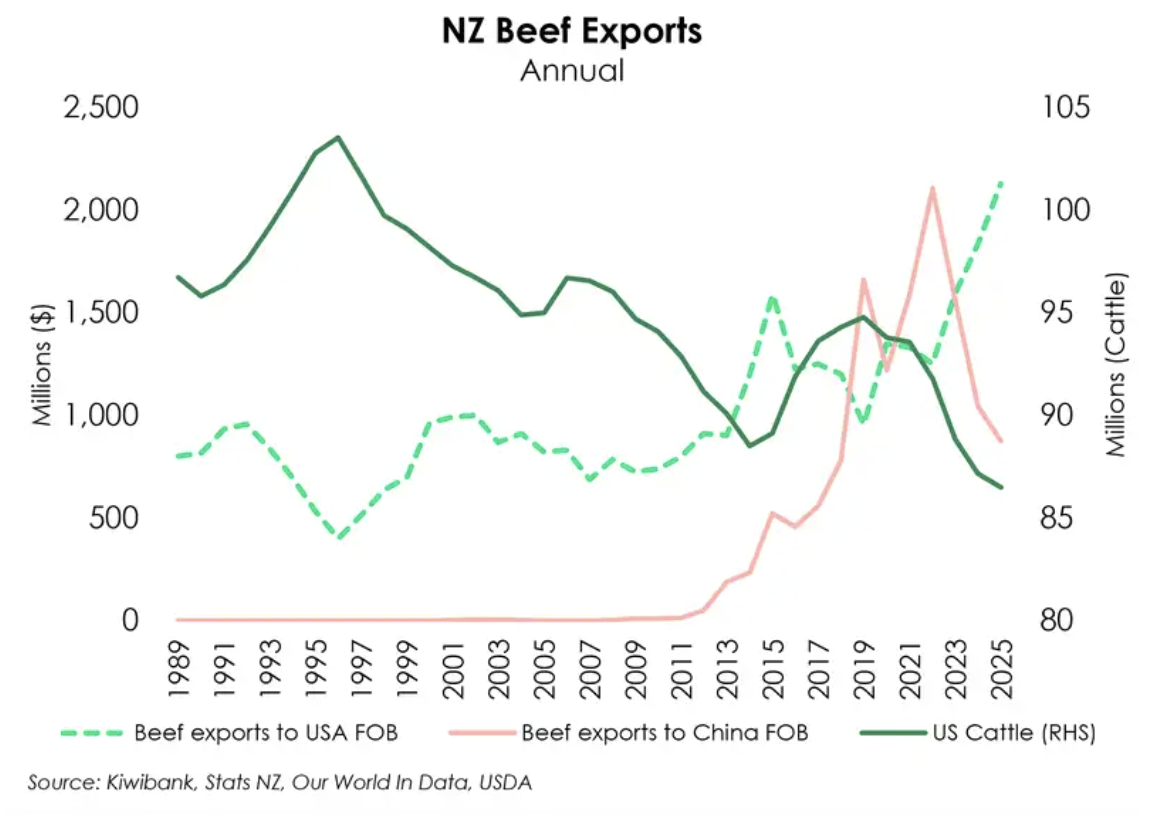
US cattle numbers have fallen to their lowest level in around 75 years, while strong consumer demand has pushed beef prices to record or near-record levels. In response, President Donald Trump has moved to temporarily increase access for imported lean beef trimmings, allowing an additional 300,000 tonnes to enter under lower, in-quota tariff rates for 90 days from 1 September. The policy is intended to increase the supply of beef available for grinding and ease prices for American consumers.
The move has proved controversial among US cattle producers, who argue that increasing imports risks weakening cattle prices at precisely the time the domestic industry needs incentives to retain breeding stock and rebuild the national herd. The underlying challenge, however, is clear: rebuilding a cattle herd takes time, while consumer demand for beef continues.
For New Zealand, the situation is particularly significant.
The US has become an increasingly important destination for New Zealand beef, with Kiwibank reporting that 2026 is on track to be another record year for NZ beef exports to the United States. In June alone, beef exports to the US represented 4.12% of New Zealand’s total export value. Kiwibank attributes the strong demand in part to the shrinking US cattle herd, alongside high global beef prices and a favourable NZD/USD exchange rate.
That creates an important point for New Zealand’s beef sector — and one that sits squarely within the Angus NZ story.
New Zealand cannot compete with the US by trying to replicate its production system. Our advantage is different: producing high-quality beef efficiently from pasture, with cattle that can convert grass into valuable kilograms of beef.
When international markets are short of beef, that production efficiency becomes increasingly valuable.
The US situation is a reminder that beef supply is not simply about how many cattle a country has. It is also about how efficiently those animals can turn available feed and land into saleable product, and how consistently that product can meet the requirements of high-value international markets.
For New Zealand’s predominantly pasture-based farming system, that reinforces the importance of genetics and animal efficiency.
Strong international demand ultimately reinforces the value of producing cattle that efficiently turn grass into kilograms of high-value beef.
The US may be looking to imports to bridge a short-term supply gap, predominantly in the supply of ground beef. For New Zealand, the opportunity is longer term: continuing to produce the type of efficient, high-quality beef that international consumers want – while making the most of the natural advantage of our pasture-based production system.
The US is also beginning to reopen its southern border to Mexican cattle, after imports were restricted for more than a year because of concerns over New World screwworm. The reopening is being phased, with the Douglas, Arizona, port reopening to cattle on August 24 and further ports expected to follow.
Mexican cattle could provide some additional supply, but economists do not expect the reopening to materially reduce US beef prices on its own. Mexico has historically supplied only around 3% of the US cattle market, meaning the additional animals are unlikely to make a significant dent in a national herd that is now at a 75-year low.
Taken together, the developments show the scale of the challenge facing the US beef industry. Washington is simultaneously looking to increase imports of beef trimmings and restore the flow of live cattle from Mexico, while the domestic herd remains severely constrained. The measures may provide some additional supply, but rebuilding the US cattle herd will take considerably longer.
Courtesy: Kiwibank