
As part of its ongoing commitment to genetic improvement and delivering value to members, Angus NZ is progressing the development of new Estimated Breeding Values (EBVs) – Body Condition Score (BCS), Hip Height (HH), and Structural Soundness (SS).
Dan Garrick and the Helical team are currently assessing the Research Breeding Values (RBVs) for both BCS and HH. RBVs are published to assess data accuracy from multiple sources and gather feedback; they serve as an important preliminary step ahead of the release of the routinely-analysed EBVs. It is anticipated that BCS and HH will be available by the end of February, with SS to follow. These new EBVs are being developed with assistance from Beef + Lamb NZ.
What are BCS and HH?
Body Condition Score (BCS) has a direct impact on profitability through its effects on reproduction and efficiency. Cows with moderate BCS (5-7 on a 10-point scale) at calving typically show optimal reproductive performance. Thin cows (BCS <4) have longer postpartum intervals, lower conception rates, and reduced weaning weights due to poor milk production. They’re also more susceptible to health problems and metabolic stress. Overly fat cows (BCS >7) face calving difficulties and can have reduced feed efficiency. The economic sweet spot is maintaining cows in moderate condition – thin enough to be feed-efficient but adequate enough for consistent reproduction and calf performance.
Hip Height (HH) serves as a proxy for mature cow size, which has significant economic implications. Larger-framed cows require more feed for maintenance, which directly impacts the cost of production. On harder hill country, moderate-framed cows often optimise the balance between weaning weight and cow maintenance costs. Extremely large cows may wean heavier calves but consume disproportionately more feed, reducing overall herd profitability. Frame size also affects longevity indirectly – oversized cows in nutritionally limited environments tend to lose body condition more readily and may leave the herd earlier.
Structural Soundness affects calving ease, rebreeding and cow longevity, all of which have economic implications also.
What new info are farmers needing to collect and record?
Body Condition Score (BCS)
BCS can be collected at different times of the year and on different parts of the cow. For more information on this please click here:
Hip Height (HH)
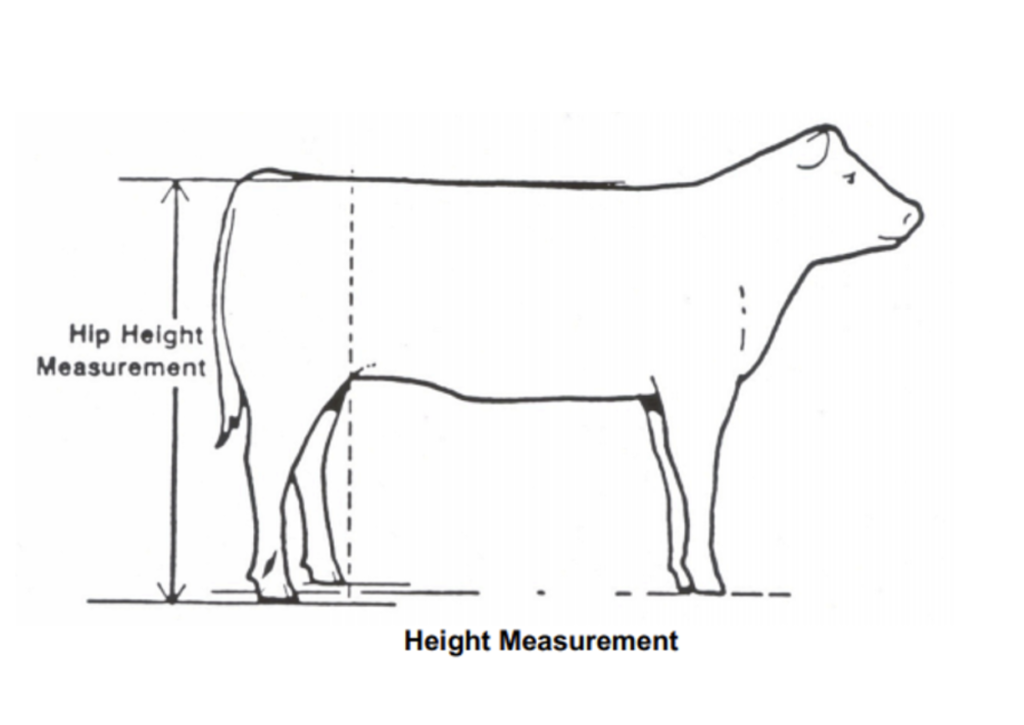
Mature cow height measurements assess the height of mature females at the hip, and are measured in cm units.
It is important to not guess/estimate height and ensure the height is recorded from the front of the animal’s hip, directly above the hook bone.
A common technique is to record height in the crush by using a livestock measuring stick or by attaching a level board horizontally to the top of the crush at a known height above the ground. When the animal is standing stationary in the crush, a tape measure can be taken from the hook bone to the board, which is then subtracted from the known height between the board and ground to give the height of the animal.
Mature cow height should only be recorded when the animal is standing stationary on level ground.
Management group information should be specified for any cow or groups of cows that have been managed differently in previous years where the difference in management is still considerably affecting their height relative to other cows born in the same year. For example, cows that have previously been part of the show team but are now part of the main herd, or in situations where some cows of the same age were calved down at different ages (e.g. 2, 2.5 and 3 years of age).
Mature cow heights should be recorded for the whole mob on the same day. Collecting “occasional” scores, or only collecting heights for a subset of cows is of no value.
The time of the production cycle at which mature cow heights have been recorded should be carefully noted when submitting measurements into Helical. i.e. weaning, pre-calving or joining.
Consideration should be given to also collecting mature weight and body condition score measurements in association with mature cow height measurements.